Adult Autism: Late Diagnosis, Masking & Finding Support
A guide to adult autism, late diagnosis, masking, the AuDHD experience, and how counselling can support autistic adults in the UK.
Key takeaways
- Autism is a neurological difference—a different way of processing the world, not a disorder to be fixed
- Many adults, especially women and those who learned to mask, weren't diagnosed as children because they didn't fit the outdated stereotype
- The autistic brain processes sensory information, social interaction, and interests differently—not worse, just differently
- Late diagnosis often brings a complex mix of relief, grief, and the need to re-examine your entire life story
- Counselling can help you unmask safely, process the emotional weight of late discovery, and build a life that actually fits how your brain works
There's a particular moment I see quite often in my work. Someone sits across from me—usually in their 30s or 40s, often after years of therapy for anxiety or depression that never quite resolved things—and says something like: "I think I might be autistic. But I'm not sure I'm allowed to say that."
That uncertainty is incredibly common. The stereotypes most of us grew up with—the nonverbal child, the maths genius, the boy who couldn't make eye contact—left out enormous numbers of people. Particularly women. Particularly anyone who learned early to watch, copy, and perform.
If you're wondering whether autism might explain something about your experience, this guide is for you. And if you've recently been diagnosed and are trying to figure out what it all means—that too.
What autism actually is
Autism is a neurological difference—a fundamentally different way your brain is wired to process information, sensory input, and the social world around you. It is not a mental illness, a disease, or something that needs curing. Autism is a lifelong neurotype that affects approximately 1 in 100 people in the UK, though many adults remain undiagnosed.
It's not the collection of deficits that older clinical descriptions made it sound like.
The diagnostic criteria were built by observing autistic people from the outside, cataloguing behaviours without understanding what was happening internally. That's why so much of the language around autism feels wrong to autistic people themselves. The experience from the inside is often quite different from how it looks from the outside.
Modern neurodiversity research offers better frameworks. One of the most useful is Monotropism—the idea that autistic brains are "interest-based." While neurotypical brains tend to spread attention across many things at once (polytropism), autistic brains tend to focus deeply on fewer things. This allows for incredible depth of knowledge and flow states, but it also means that being pulled away from a focus—or having to divide attention—can feel genuinely painful.
This isn't a quirk. It's a fundamental difference in how attention, processing, and energy work.
Why you might have been missed as a child
This is something I see constantly in my work. Adults—often highly capable, often exhausted—who were simply invisible to the diagnostic criteria as children.
For decades, autism was understood as something that affected young boys who couldn't make eye contact, lined up their toys, and struggled obviously in social situations. That narrow picture left out enormous numbers of people.
You might have been overlooked because you learned early to watch others and copy what they did. You figured out the "rules" through observation and logic rather than intuition—and because you could follow them, nobody realised how much effort it took. This is called masking, and it's exhausting in ways that are hard to explain to people who've never had to do it.
If you were socialised as female, you were even more likely to be missed. Autism often presents differently in women and girls—less external disruption, more internal struggle. You might have been called "shy" or "sensitive" or "anxious" rather than recognised as autistic.
If you're intelligent, you probably used that intelligence to compensate. You logically deduced social rules that others seemed to know instinctively. You got through school. You held down jobs. From the outside, you looked fine—but inside, you were working twice as hard as everyone else to achieve the same results.
And if you did seek help, you might have been treated for the consequences of undiagnosed autism—anxiety, depression, OCD, eating disorders—without anyone looking at what was underneath. The real issue stayed hidden while you collected diagnoses that never quite fit.
The sensory world
This is often where autistic experience diverges most sharply from neurotypical experience. It's not just about finding loud noises unpleasant. It's about how your entire nervous system filters—or fails to filter—the world around you.
You might be hypersensitive: hearing the electrical hum of lights that others insist are silent, finding clothing tags unbearable, smelling someone's perfume from across the room, or feeling overwhelmed in environments that others find perfectly comfortable.
Or you might be hyposensitive in some areas: needing deep pressure to feel grounded, seeking out intense sensory input, or not noticing hunger or thirst until you're genuinely unwell.
Most autistic people have a complex sensory profile—hypersensitive to some things, hyposensitive to others, and it can shift depending on stress levels and how depleted you are.
And then there's the crash. After a day of sensory input—office lighting, background chatter, the commute, all of it—you need absolute silence and darkness to recover. People around you might read this as antisocial. It isn't. Your nervous system is overloaded and it needs to come back down. That's physiology, not personality.
Social interaction and the double empathy problem
For years, autistic people were told they lacked empathy and social skills. This always felt wrong to autistic people themselves, and research now supports what they've been saying all along.
The Double Empathy Problem reframes the so-called "social deficit." It points out that autistic people communicate perfectly well with other autistic people, and neurotypical people communicate well with each other. The difficulty only emerges when these two different communication styles try to interact. It's a mismatch, not a deficit—and the responsibility for bridging it doesn't fall solely on autistic people.
You might prefer direct, honest communication and struggle with subtext, hints, and "reading between the lines." You might find small talk draining and pointless, but you could talk for hours about something that genuinely interests you. You might mentally rehearse conversations before having them, scripting what to say to make sure you get it right.
None of this means you don't care about people. Many autistic people care deeply—sometimes too deeply, feeling others' emotions so intensely that it becomes overwhelming.
Routine and the need for predictability
Routine isn't about being rigid or inflexible for its own sake. It's about energy conservation in a world that's inherently unpredictable and overwhelming.
When you're constantly processing more sensory information than others, when social interaction requires conscious effort, when your nervous system is working overtime just to get through the day—routine provides an anchor. It reduces the number of decisions and unknowns your brain has to process, freeing up resources for everything else.
That's why unexpected changes can feel so destabilising. It's not that you're being difficult. Your brain genuinely needs time to recalibrate when plans shift without warning. A last-minute change that a neurotypical person might absorb without thinking can send your whole system into overload.
The comfort you find in repetition—watching the same shows, eating the same foods, listening to the same music—isn't childish or boring. It's regulating. These predictable pleasures provide a safe space where your brain can rest.
When it's both: the AuDHD experience
AuDHD is the term used to describe the experience of being both autistic and having ADHD. Research suggests that between 50-70% of autistic people also meet the criteria for ADHD, making this dual neurotype far more common than was previously recognised. Many people who discover they're autistic later in life also discover they have ADHD, and understanding how these two conditions interact can be transformative.
If that's you, you might have felt confused by contradictions in yourself that finally make sense through this lens.
Your autistic side craves routine and predictability. Your ADHD side demands novelty and gets bored instantly. You might be hyper-organised in one area of life while living in chaos in another. The two conditions can mask each other, making both harder to recognise.
I can't be autistic because I'm too impulsive.
I can't have ADHD because I can focus for hours on things I care about.
If both statements feel partially true and partially wrong, that's worth exploring.
How AuDHD shows up in daily life
The combination creates unique challenges that neither diagnosis alone fully explains:
- Energy management becomes particularly complex. Your autistic need for recovery time after social interaction conflicts with ADHD's restlessness and need for stimulation. You might feel simultaneously exhausted and unable to rest.
- Emotional regulation is doubly affected. Both autism and ADHD affect how you process and manage emotions. Together, they can create intense emotional experiences—heightened sensitivity from the autistic side combined with the impulsivity and emotional flooding of ADHD.
- Masking becomes even more layered. You may have been masking both your autistic and ADHD traits, performing a neurotypical version of yourself that requires enormous energy. The burnout from this double masking can be profound.
- Executive function is affected from two directions. Autism may make you want to plan everything in advance; ADHD may make it impossible to follow through on those plans. The gap between intention and action can feel maddening.
- Sensory needs may conflict. Your autistic side might need quiet and predictability; your ADHD side might crave stimulation and novelty. Finding environments that satisfy both can feel like an impossible balance.
Why AuDHD is often missed
The two conditions frequently mask each other in clinical assessments. ADHD's impulsivity and sociability can hide autistic traits. Autism's ability to focus deeply can look like it rules out ADHD. Many clinicians still assess for one or the other rather than considering both. This means AuDHD individuals often receive only a partial diagnosis—or are misdiagnosed with anxiety and depression instead.
Understanding the intersection of these two neurotypes creates its own particular experience—and for many people, it's the missing piece that finally makes everything make sense.
But what if I'm not really autistic?
If you're reading this and thinking "I can't be autistic because I have friends" or "I make eye contact" or "I'm not like the autistic people I see in media"—you're battling stereotypes, not reality.
Many autistic people have deep, meaningful friendships. The difference is often in how those friendships work, how much energy they require, and what recovery looks like afterwards. You might be the life of the party on Saturday night—and then need to sleep for most of Sunday. That's not contradiction; that's the social hangover that comes from performing neurotypicality.
You might make eye contact, but you've had to consciously learn how. You count seconds, look at people's noses, or force yourself through it despite it feeling deeply uncomfortable. The ability to do something doesn't mean it comes naturally.
And the autistic people you see represented in media are usually a narrow slice of the spectrum, often portrayed by non-autistic actors working from non-autistic writers' assumptions. Real autistic people look like everyone else, because they are everyone else—just with a different neurological setup running underneath.
The cost of masking
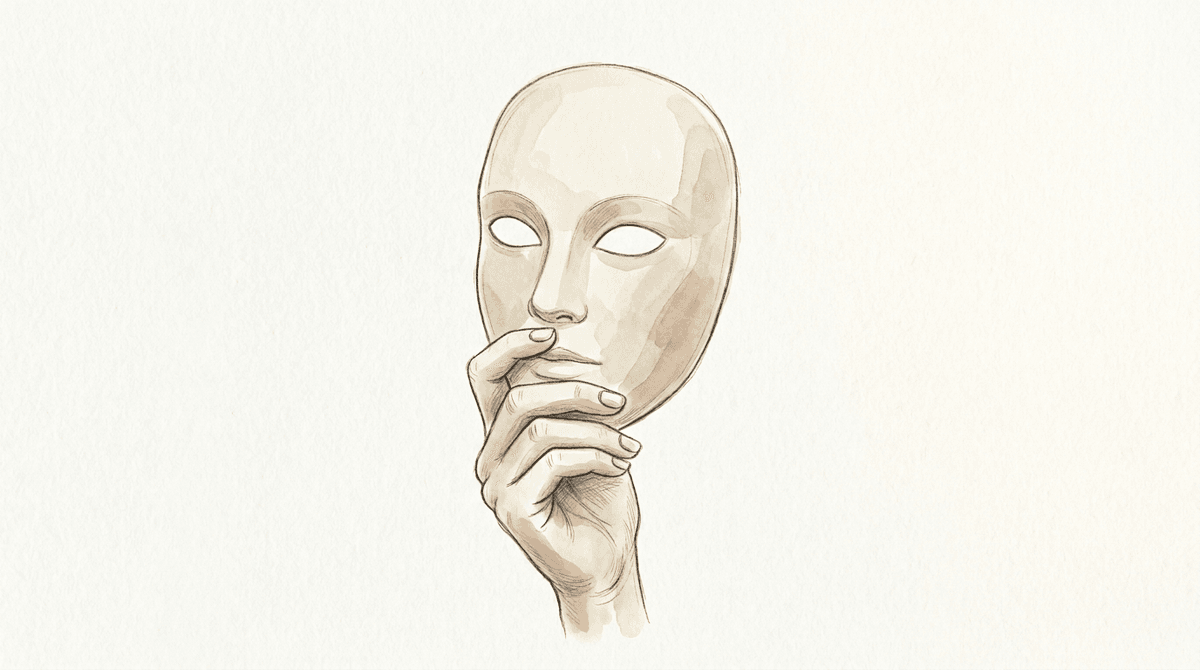
Masking is the conscious or unconscious suppression of autistic traits in order to fit in. Making eye contact when you'd rather not. Suppressing the movements that help you regulate. Nodding and smiling when you're lost. Running a constant internal translation service between how you actually experience the world and how you're expected to present.
It works, in the sense that it gets you through situations. But the cost accumulates over years.
Think of it like running an emulator—pretending to be a different operating system while your real one runs underneath. That takes processing power. Enormous amounts of it. And eventually, the system crashes.
Autistic burnout is that crash. Not ordinary tiredness—a genuine collapse of cognitive and physical resources. Skills you relied on may disappear. Speech might become difficult. Basic tasks feel impossible. It looks like depression from the outside, and is often misdiagnosed as such. But rest alone doesn't fix it. What's needed is the chance to stop masking—and that requires an environment safe enough to do so.
Navigating diagnosis in the UK
If you're considering a formal diagnosis, you have options:
- Through the NHS: You can ask your GP for a referral to a local autism assessment service. This is free, but waiting times are currently very long—often several years depending on where you live.
- Going private: You can pay for an assessment directly. This is faster (weeks to months rather than years) and typically results in a detailed report. Costs vary but generally range from £1,000 to £2,500.
- Right to Choose (England only): Under NHS England rules, you may have the right to request that your GP refers you to a specific provider (such as Psychiatry UK) who can see you sooner, with the NHS covering the cost. It's worth asking your GP specifically about this option.
Whether or not you pursue formal diagnosis, your experience is valid. Diagnosis can be helpful for accessing support, but it doesn't change who you are. You're already autistic (or not)—the assessment just provides external confirmation.
What late diagnosis feels like
Discovering you're autistic in your 30s, 40s, or later sets off something complicated. Almost everyone I've worked with through this process describes the same initial wave of relief: I'm not broken. There's a reason for all of this. I'm not alone.
But relief rarely comes alone. There's grief too—for the younger version of yourself who struggled without understanding why, who blamed themselves for things that weren't their fault, who might have had an easier time with the right support. There can be anger at the professionals who missed it, at a society that made you mask so hard you lost track of who you really were.
And then there's the strange work of re-examining your entire history through this new lens. Every friendship, every failure, every moment of confusion—all of it looks different now. This can be disorienting even when it's also clarifying.
These responses don't resolve quickly. They take time to work through. And they're often helped by having someone who understands to talk them through with.
How counselling can help
What I offer isn't what a lot of autistic adults have experienced from therapy before. It's not about teaching you social skills. It's not CBT worksheets designed for neurotypical brains. And it's absolutely not about making you "more normal."
In my experience, what autistic clients need most is a space where they can stop performing. Many of my clients tell me our sessions are one of the only places they don't have to mask. That in itself is therapeutic—sometimes profoundly so.
Beyond that safe space, we can work on specific things: understanding your sensory profile and what actually depletes you versus what helps. Processing the grief that comes with late diagnosis—the anger at being missed, the sadness for your younger self. Exploring what it means to build a life around your actual needs rather than the ones you've been pretending to have.
I've also found that many autistic clients benefit from a more direct, transparent therapeutic relationship. I'll tell you what I'm thinking. I won't rely on subtext. If something isn't working, I'd rather you tell me straight—and I'll do the same.
Finally
However you found your way to this page, something brought you here for a reason. Trust that.
The process of understanding yourself—whether or not it leads to a formal diagnosis—is worthwhile in itself. I've watched clients move from "I think something might be different about me" to a genuine, grounded sense of who they are. It doesn't happen overnight. But it happens.
If you want a space to explore this, you don't need to arrive with answers. Most people arrive with questions. That's exactly the right place to start.
About the author
Nadia Wilkinson is a BACP registered counsellor (Member No. 394901) and HCPC registered Educational Psychologist specialising in supporting adults with ADHD, autism, anxiety, and emotional wellbeing. She offers online counselling across the UK.
References:
- National Autistic Society: autism.org.uk
- Milton, D. (2012). "On the ontological status of autism: the 'double empathy problem'" — Disability & Society
- Murray, D., Lesser, M., & Lawson, W. (2005). "Attention, monotropism and the diagnostic criteria for autism" — Autism